

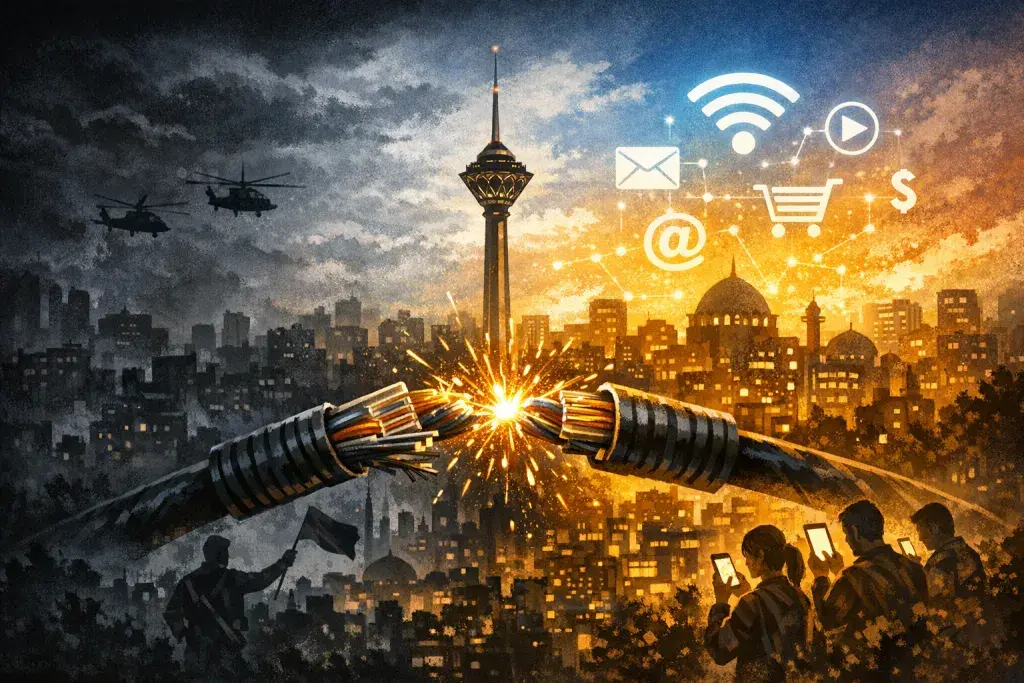
After 46 days of near-total disconnection, Iran has begun restoring limited internet access, with residents in Tehran and other major cities reporting that basic access to major global web services has returned. The move matters for more than daily communication: it signals that the economic cost of the shutdown has become too severe for the state to sustain.
A blackout imposed for control, then strained by cost
The shutdown began at the outset of the war, when the authorities moved to restrict the flow of information during American and Israeli bombing campaigns and to suppress domestic dissent. In practice, internet blackouts serve several functions for authoritarian states at once: they disrupt reporting from the ground, make protest coordination harder, and narrow the public’s access to outside accounts of events.
But a modern economy cannot be cleanly separated from its networks. The reported daily loss of $37 million to $42 million, adding up to roughly $2.5 billion over the blackout period, points to the scale of that dependence. Iran’s digital economy was hit especially hard, with 4 to 5 million people said to rely on online platforms for income and online sales falling by 80 percent during the shutdown.
The damage spread far beyond online retail
The losses were not confined to small sellers and app-based work. Internet access now underpins logistics, payments, customer service, procurement, scheduling and basic communication across industries. When those connections are cut, factories struggle to coordinate supplies, service firms lose contact with clients, and businesses that are not formally “digital” still find themselves stalled.
The shock was also visible in financial markets. According to the figures cited in local reporting, the Tehran Stock Exchange lost 450,000 points in the first four days of the blackout. That decline reflected more than investor panic; it showed how quickly a communications shutdown can feed into wider fears about state capacity, business continuity and the country’s economic outlook.
Partial restoration does not mean digital normality
The return of limited access is not the same as an open internet. Many social platforms remain restricted, and traffic is still closely monitored. That matters because partial connectivity allows the state to relieve economic pressure while preserving much of its control over speech, visibility and organization online.
For ordinary Iranians, the reopening may restore basic tasks that had become difficult or impossible, from commercial transactions to contact with relatives abroad. For businesses, it may restart interrupted activity. Yet the episode has also reinforced a harsh lesson: when internet access depends on political calculation, the digital economy remains structurally fragile.
What the shift suggests about the regime’s priorities
The decision to reconnect the public, even in limited form, suggests that the authorities are balancing repression against economic survival. States can absorb public anger for a time, but prolonged communications blackouts impose direct costs on tax revenue, employment and the functioning of the private sector. In a country already dealing with war damage and pressure on infrastructure, that burden becomes harder to ignore.
That does not point to liberalization. It points to necessity. The restoration appears to be a controlled adjustment by a government trying to restart commerce without surrendering its grip on information. Whether that balance can hold will depend on conditions beyond the network itself: the course of the conflict, the stability of the economy and the regime’s tolerance for public visibility in a period of strain.
