
On the afternoon of Friday 27 March, a sectarian mob of more than a hundred men descended on Al-Suqaylabiah, a predominantly Christian town in Syria's Hama governorate, smashing windows, destroying shops and cars, and firing bullets into the walls of local businesses. For Molham, an engineer who had spent years building a family-oriented café with his pregnant wife, it was the moment every small business owner in a fragile security environment quietly dreads - and hopes will never come. It did come. What he did in the days that followed says as much about the psychology of survival as it does about faith.
What the Mob Was Really Targeting
The immediate trigger was a dispute at one of the area's cafés, where a group of men from an outside village were barred entry. The café operated on a families-only policy - a deliberate social boundary common in conservative regions of Syria, where such establishments serve as protected spaces for women and children in a public sphere that has grown increasingly unsafe since the fall of the Assad government in late 2024. Being turned away was apparently enough provocation. Within hours, the dispute had escalated from an argument into an organized incursion.
Molham's read of events is unambiguous. "It wasn't just a fight between boys," he says. "It was an attack on our existence." Al-Suqaylabiah's Christian character - the culture of mixed-gender social spaces, the Easter calendars on walls, the absence of strict dress codes - made it a visible target for those who resent what it represents. The attack fits a broader pattern documented across post-conflict Syria and other regions experiencing rapid shifts in governing authority: minority communities, even those with deep local roots and no political profile, face acute vulnerability during transitional periods when institutional protection collapses and armed actors fill the vacuum.
Armed men entering civilian spaces, as Molham describes happening routinely at his café since the government changed, is not incidental intimidation. It is a form of low-grade coercion that precedes more organized violence, testing the boundaries of what a community will tolerate before that tolerance calcifies into submission.
The Weight a Family Carries Home
When Molham recognized that the mob was heading for his café, he made two decisions in quick succession: get his pregnant wife and five-year-old daughter, Christina, to safety, then return to evacuate his customers. He locked the doors, turned off the lights and fled. It was, by any measure, a controlled response under conditions of extreme duress. But control in the body does not mean calm in the mind - or in the minds of those watching.
Christina's trauma has settled into the ordinary rhythms of daily life. A missed call from her father is no longer merely a missed call - it signals, to a five-year-old's nervous system, that the worst has returned. She begs her mother to call him. She held his hand during the attack and said, "Papa, come hide with me." These are the details that do not appear in any incident report, but they are where the true human cost of communal violence concentrates: in the interpretive frameworks that young children build from fear, which can persist long after the physical environment has been repaired.
Molham is also carrying a question that the attack placed squarely in front of him, as his second daughter's birth approaches: "I find myself questioning if it is right to bring another child into a world like this." That question, asked by a father in a damaged café in central Syria, echoes across every community where safety has become something that cannot be assumed.
Bullet Holes and Easter Lilies
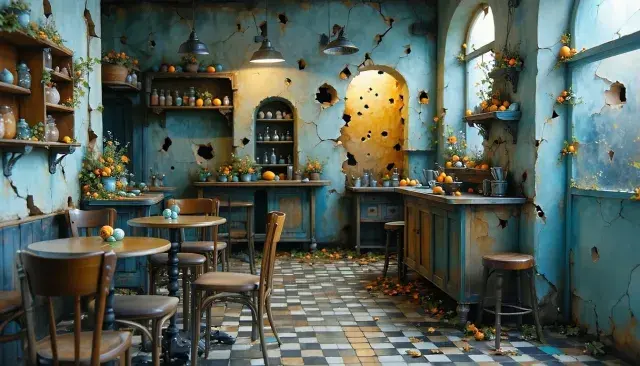
In the days after the attack, as Easter approached, Molham did not rush to plaster over the damage. He covered the bullet holes in his walls with Easter decorations. The gesture was deliberate, layered, and communicated something that a repair crew with fresh paint could not: that the community had seen what was done to it, that it was not pretending otherwise, and that it was choosing to mark the wounds rather than erase them.
The symbolism aligned consciously with the Christian theology of Easter - the idea that death and destruction do not have the final word, that what is broken can become the very site of renewal. Whether one holds that belief or not, the act itself was a form of public witness. It refused the logic of shame that often accompanies targeted violence, where communities feel compelled to restore appearances quickly in order to signal normalcy and avoid further attention. Molham's café, decorated scars and all, said something different: we are still here.
Resilience in a Narrowing Space
Al-Suqaylabiah sits in a part of Syria where Christian communities have maintained a continuous presence for centuries. That presence has survived successive waves of regional upheaval, but the post-2024 transition has introduced a new kind of pressure - less the catastrophic displacement of earlier conflict years and more the grinding, cumulative effect of living under the gaze of armed strangers, of recalibrating every public behavior, of wondering whether a business built on a vision of peaceful coexistence can survive in an environment that no longer reliably protects it.
Molham says he has considered closing the café permanently, not because it failed commercially but because he was terrified for his wife's safety. That calculation - weighing the value of a livelihood against the cost of the exposure it creates - is one that minority business owners in volatile regions face with a frequency that rarely reaches broader public awareness. The café was repairable. The sense of safety it was built to provide is something harder to reconstruct.
"We believe in God's plan for us," Molham says. "And we will keep fighting to live in peace." It is a statement of faith, but also of intention - a refusal to allow one brutal afternoon to determine what comes next, for his family or for his community.