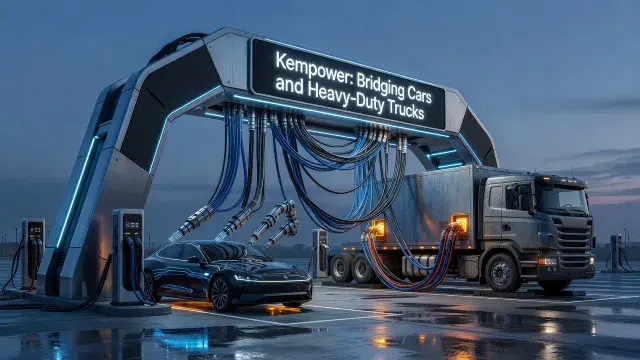
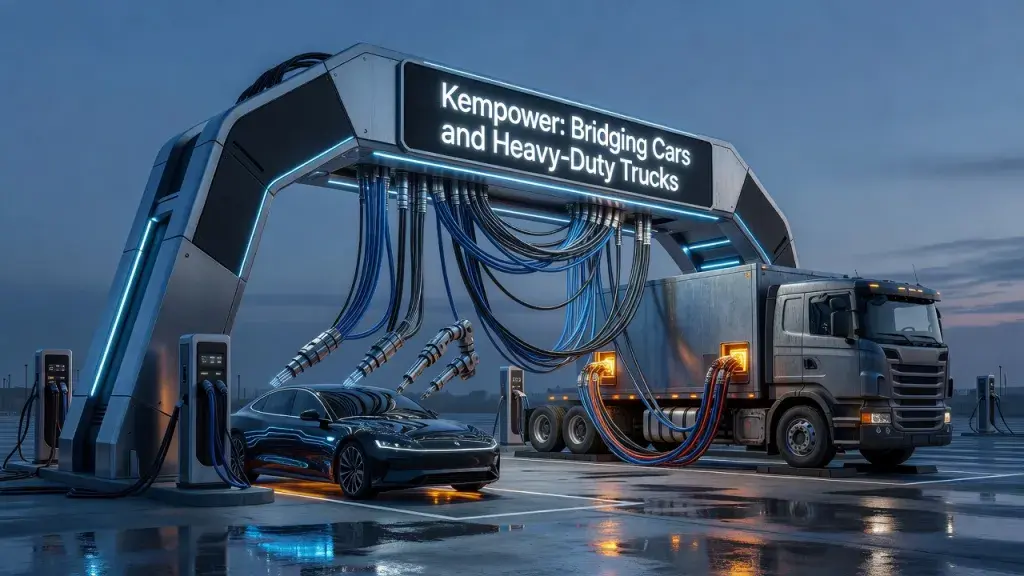
Kempower has introduced a charging unit designed to solve one of the electric trucking industry's most stubborn infrastructure problems: the fact that cars and heavy-duty trucks currently need separate, incompatible charging systems. The new Mega Satellite Flex, unveiled this week at ACT Expo in the United States, supports both the established CCS standard, at up to 560 kW, and the emerging Megawatt Charging System, at up to 1.2 MW, from a single dispenser.
The timing reflects where the industry actually stands. CCS remains the default for passenger EVs and has for years, while MCS is only now being built out to serve trucks that require dramatically more power to keep long-haul routes viable. Site operators weighing where and how to invest in charging infrastructure face a similar set of practical questions to those drivers ask about their own digital tools - for instance, understanding how to turn the kill switch on before trusting a connection with sensitive data. In both cases, the underlying issue is building systems that fail safely and perform reliably under changing conditions, rather than assuming today's setup will suit tomorrow's demands.
One Site, Two Standards
Kempower's pitch centers on avoiding duplicate infrastructure. Historically, a charging site built for passenger vehicles would need a separate, costly buildout to accommodate trucks later, since the power and connector requirements diverge sharply. The Mega Satellite Flex removes that fork in the road by serving both from day one. It also supports 800-volt EV architectures, an increasingly common design in newer vehicles that allows for faster charging when paired with compatible hardware.
For an operator, that flexibility translates directly into economics. A dispenser that can serve any vehicle pulling into a site, whether a sedan or a long-haul truck, sees more consistent use than one locked to a single standard. Higher utilization from the outset shortens the timeline for recovering the capital cost of installation, which matters considerably at a moment when charging networks are still being built out and margins remain tight.
Technical Specifications
The unit is built to handle serious current loads on both sides of its dual capability:
- Up to 1,500 amps for Megawatt Charging System connections
- Up to 700 amps for CCS connections
- A 5-meter (16.4-foot) cable for CCS
- A 2.7-meter (8.86-foot) cable for MCS
- Optional integrated payment terminal
It is also compatible with Kempower's existing distributed charging architecture, meaning operators who already run Kempower systems can add the Mega Satellite Flex without redesigning their site layouts or replacing existing hardware.
What Comes Next
Kempower plans to bring the Mega Satellite Flex to market in North America and Europe in July 2026, giving fleet operators and charging network developers over a year to plan deployments. The broader significance lies less in the specific wattage figures than in the strategic bet the design represents: that the next phase of EV infrastructure will not be built as two parallel networks, one for cars and one for trucks, but as shared sites engineered to serve whatever vehicle arrives. Whether that consolidation becomes the industry norm will depend on how quickly MCS adoption spreads among truck manufacturers and fleets, but Kempower is wagering that the answer is soon.