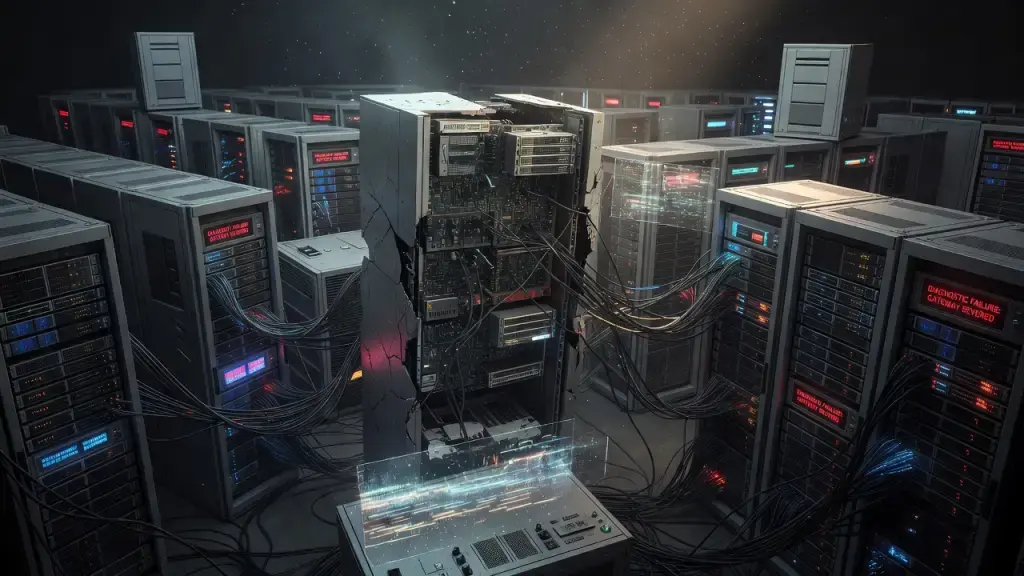
On 8 January 2026, Iran's government switched off the country's connection to the rest of the world. For more than 90 million people, the internet simply stopped working - not just the open web, but the government's own domestic intranet, VPN tunnels, text messaging, mobile calls, and even landlines. It was the first full information blackout in the country's history, and connectivity has never fully recovered since.
A Shutdown Built Into the Architecture
The speed and completeness of the blackout was not an accident of circumstance. It was a function of design. Iran's internet infrastructure is far more centralized than that of the United States or most of Europe, where thousands of independent providers exchange traffic across countless routes, making a total shutdown technically difficult. In Iran, the bulk of international traffic flows through a small number of gateways controlled by state-linked telecom operators. Cutting a handful of connections is enough to sever tens of millions of people from the outside world.
That architecture did not emerge overnight. Over the past decade, Iranian authorities have built out what they call the National Information Network, a domestically routed system that keeps banking, government services, and local platforms running on infrastructure physically located inside the country. The design allows officials to throttle or disconnect the global internet entirely while keeping select domestic functions alive - a form of control unavailable to governments with more decentralized networks. Deep packet inspection, a technique that lets the Telecommunication Company of Iran examine data packets in real time, adds another layer, enabling authorities to detect and block VPN traffic, messaging apps, and social platforms even when full shutdowns aren't in effect.
When the Network Fails, Satellites Fill the Gap
The January shutdown followed nationwide protests over Iran's economic crisis and political repression, among the most significant demonstrations since 1979. The government's crackdown was severe, with death toll estimates running into the thousands and some assessments suggesting the real figure could be far higher. Weeks after the initial shutdown, airstrikes by the United States and Israel in late February triggered a second wave of near-total restrictions.
Into that vacuum, a system called Toosheh - Persian for "knapsack" - began broadcasting. Rather than relying on the internet at all, Toosheh transmits data over ordinary free-to-air satellite TV signals, which remain widely accessible in Iran despite being officially banned. Because these broadcasts are unencrypted, a receiver and dish - equipment present in a majority of Iranian households - are enough to pull down the signal. Toosheh software hides documents, news articles, and software tools inside the same MPEG transport stream format used for audio and video, so a satellite receiver cannot distinguish the payload from ordinary programming.
One-Way Broadcasting as a Resilience Strategy
The system does not function like the internet. There is no request and response, no browsing. Instead, Toosheh behaves more like a broadcast magazine, pushing one to five gigabytes of curated material - news reports, first-aid instructions, software for circumventing censorship, and guidance on connecting securely to satellite terminals - to anyone capturing the signal. Because it is one-way and broadcast-based, it sidesteps the blocking techniques that work against two-way internet traffic. There is also no log of who received what, which matters enormously under a government known for surveillance and retaliation against dissidents.
The main vulnerability is signal jamming. Iran has used it before, including an uplink interference campaign in 2009 that disrupted the satellite itself and drew the threat of international sanctions, prompting Tehran to abandon the tactic in 2012. That history suggests outright satellite jamming carries real diplomatic costs, which may explain why broadcast-based workarounds like Toosheh have persisted even as internet-based circumvention tools are blocked almost as fast as they appear.
What the Blackout Signals Going Forward
Iran's experience offers a preview of a tactic other governments facing unrest could adopt: total disconnection rather than selective censorship. It also underscores why digital rights advocates increasingly treat network architecture itself as a political question. Where infrastructure is centralized, a government holds a kill switch. Where it is distributed, as in most democracies, that kind of blackout is far harder to engineer. For ordinary Iranians, the lesson of January 2026 is blunt: access to information is no longer guaranteed by having a phone or a modem. It depends on what lies underneath the network, and who controls it.